Moist Lemon Sheet Cake with Lemon Cream Cheese Frosting
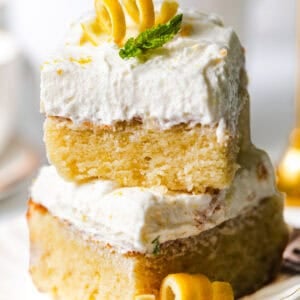
This moist lemon sheet cake is made from scratch with fresh lemon flavor and topped with fluffy lemon cream cheese frosting. Easy and perfect for a crowd!
Equipment
- Stand Mixer (or electric hand mixer)
- 9x13 baking dish (metal or ceramic)
Ingredients
- 2 1/4 cups (450 g) Sugar
- 3 tbsp Lemon Zest
- 3/4 cup (168 g) Vegetable Oil
- 1/2 cup (113 g) Salted Butter, (room temperature)
- 4 large (200 g) Eggs, (room temperature)
- 1 1/2 tbsp Lemon Emulsion
- 2 tsp Vanilla Extract
- 1 tsp Almond Extract
- 1/4 cup (60 g) Lemon Juice
- 3 3/4 cups (450 g) Cake Flour, (see notes for all purpose flour substitution)
- 1 tbsp Baking Powder
- 1 tsp Kosher Salt
- 1 1/2 cup (360 g) Whole Milk, (room temperature)
Lemon Cream Cheese Frosting
- 1 cup (227 g) Salted Butter, (room temperature)
- 4 cups (500 g) Powdered Sugar
- 2 tbsp (30 g) Lemon Juice
- 1 tsp Lemon Emulsion
- 4 oz (113 g) Cream Cheese, (room temperature)
Instructions
- Preheat the oven to 350 degrees F. Grease and flour a 9x13 baking pan, tap off any excess flour. You can also line with parchment paper. Set aside.
- In a large bowl, mix together the dry ingredients - all purpose flour, baking powder, and kosher salt. Set aside. 3 3/4 cups Cake Flour 1 tbsp Baking Powder 1 tsp Kosher Salt
- Add sugar and lemon zest to the bowl of a stand mixer. Rub the lemon zest into the sugar for about 3 minutes, until the sugar takes on a fragrant smell and becomes slightly pale yellow in color. 2 1/4 cups Sugar 3 tbsp Lemon Zest
- Use the leftover zested lemons and cut them in half. Squeeze the lemon juice into a small bowl until you have 1/4 cup (60g). Set aside. 1/4 cup Lemon Juice
- Add butter and vegetable to the lemon sugar mixture. Fit stand mixer with the paddle attachment and mix together on medium speed for 5 minutes, scraping down the sides midway through. 3/4 cup Vegetable Oil 1/2 cup Salted Butter
- Reduce mixer speed to low speed, begin adding eggs, one at a time, ensuring each egg is fully incorporated prior to adding the next. Scrape down the sides of the bowl and then add lemon juice, lemon emulsion (or lemon extract), vanilla extract, and almond extract. Continue to mix on low speed until combined, about 30 seconds to 1 minute 4 large Eggs 1/4 cup Lemon Juice 1 1/2 tbsp Lemon Emulsion 2 tsp Vanilla Extract 1 tsp Almond Extract
- Add half of the dry ingredients and continue to mix until the flour is fully incorporated. Scrape down the sides of the bowl and pour in the whole milk. Mix until combined, about 10-20 seconds, then add remaining flour mixture and mix until smooth, about 20 seconds. 1 1/2 cup Whole Milk
- Remove the bowl from the stand mixer and scrape down the sides of the bowl again just to ensure the batter is fully incorporated and smooth. Pour the batter into the prepared pan. Smooth into an even layer and bake for 42-48 minutes, until a toothpick inserted into the center of the cake comes out with just a few moist crumbs.
- Allow the cake to cool in the pan for 20 minutes, then turn over onto a wire rack. Cover with plastic wrap and allow it to cool completely (this traps in steam, keeping the cake nice and moist!).
- While the cake is cooling, make the lemon cream cheese frosting. Add butter to the bowl of a stand mixer fitted with the paddle attachment. Beat the butter for 4 minutes on medium speed, then add 2 cups of powdered sugar. Mix on low for about 30 seconds to get the powdered sugar incorporated, then increase to medium high speed until the smooth. Add remaining powdered sugar, lemon juice, and lemon emulsion and continue to mix until smooth and fluffy, about 2 minutes. 1 cup Salted Butter 4 cups Powdered Sugar 2 tbsp Lemon Juice 1 tsp Lemon Emulsion
- With the mixer going, add cream cheese slowly, (I like to cut the cream cheese into 4 small pieces and I add one piece at a time until it's fully incorporated and smooth). This should take about 1 minute. Scrape down the sides of the bowl and mix for another 15-20 seconds. 4 oz Cream Cheese
- Add the frosting on top of the cooled cake and serve. Garnish with additional lemon zest or fresh lemon slices.
Notes
Flour substitution: If using all purpose flour, use 467g instead of 450g.
Tips
- Cover the cake while it cools. Covering the slightly warm cake traps some steam and helps prevent it from drying out.
- Use room-temperature ingredients. Bring the butter, eggs, milk, and cream cheese to room temperature before mixing. This helps the ingredients blend evenly and creates a smoother batter with a uniform crumb.
- Measure the flour by weight. For the best texture, use a kitchen scale and measure 450g of cake flour. Too much flour can make the lemon sheet cake dry or dense.
- Zest the lemons before juicing them, and avoid the bitter white pith beneath the yellow skin.
- Avoid over-mixing the batter. Once the flour is added, mix only until the ingredients are combined. Overmixing develops too much gluten and can make the cake firm, chewy, or slightly gummy.
Nutrition
Calories: 634kcal, Carbohydrates: 82g, Protein: 6g, Fat: 32g, Saturated Fat: 15g, Polyunsaturated Fat: 7g, Monounsaturated Fat: 8g, Trans Fat: 1g, Cholesterol: 102mg, Sodium: 412mg, Potassium: 105mg, Fiber: 1g, Sugar: 59g, Vitamin A: 733IU, Vitamin C: 4mg, Calcium: 98mg, Iron: 1mg
Nutrition information is automatically calculated, so should only be used as an approximation.
Tried this recipe?Mention @BritneyBreaksBread or tag #BritneyBreaksBread!