Cinnamon Roll Bundt Cake
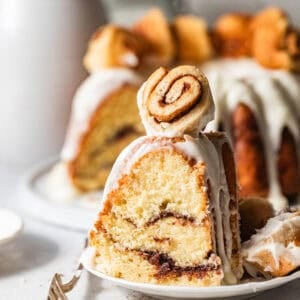
This cinnamon roll Bundt cake has a buttery, moist crumb, double cinnamon swirl, and luscious vanilla bean cream cheese glaze seeping into every nook and cranny!
Ingredients
- 1 1/4 cups Salted Butter, (room temperature)
- 6 oz Cream Cheese, (room temperature)
- 3 cups Powdered Sugar
- 5 large Eggs, (room temperature)
- 1 tbsp Vanilla Extract
- 2 1/2 cups All Purpose Flour
- 1/4 tsp Nutmeg
- 1/2 tsp Baking Powder
- 1/2 tsp Kosher Salt
- 3 tbsp Heavy Cream
Cinnamon Roll Filling
- 1/2 cup Brown Sugar
- 1 tbsp Cinnamon
- 2 tbsp All Purpose Flour
Cinnamon Simple Syrup
- 1/3 cup Water
- 1/3 cup Sugar
- 1 tsp Cinnamon
Cream Cheese Glaze
- 2 oz Cream Cheese, (from above, room temperature)
- 4 tbsp Salted Butter, (room temperature)
- 1 3/4 cups Powdered Sugar
- 2 tbsp Heavy Cream
- 1 tsp Vanilla Bean Paste, (or vanilla extract)
Instructions
- Preheat the oven to 325°F. Generously grease a 10- to 12-cup Bundt pan with baking spray containing flour, making sure to coat every groove and the center tube.
- Make the cinnamon filling. In a small bowl, whisk together the brown sugar, cinnamon, and flour until evenly combined. Set aside. 1/2 cup Brown Sugar 1 tbsp Cinnamon 2 tbsp All Purpose Flour
- In a separate bowl, whisk together the dry ingredients - flour, nutmeg, baking powder, and kosher salt. 2 1/2 cups All Purpose Flour 1/4 tsp Nutmeg 1/2 tsp Baking Powder 1/2 tsp Kosher Salt
- Add the softened butter, cream cheese, and powdered sugar to the bowl of a stand mixer fitted with the paddle attachment. Begin mixing on low speed for 1 minute and as the powdered sugar begins to become incorporated into the butter/cream cheese, increase to medium speed and mix 5 minutes, scraping down the bowl with a rubber spatula as needed, until the mixture is very light and fluffy. 1 1/4 cups Salted Butter 6 oz Cream Cheese 3 cups Powdered Sugar
- Reduce mixer to low speed and begin adding eggs, one at a time, ensuring that each egg is fully incorporated prior to adding the next. Scrape down the sides of the bowl after adding eggs and add vanilla extract and heavy cream. Mix until smooth and combined. 5 large Eggs 1 tbsp Vanilla Extract 3 tbsp Heavy Cream
- Add half of the dry ingredients to the batter and mix until just combined, about 10-15 seconds. Add the remainder of the dry ingredients and mix until smooth. Remove the bowl from the stand mixer and scrape down the sides of the bowl, ensuring that the batter is smooth and everything is fully incorporated.
- Spoon about one-third of the batter into the prepared Bundt pan and spread it into an even layer. Sprinkle half of the cinnamon-sugar filling over the batter, keeping it slightly away from the edges of the pan. Add another third of the batter, followed by the remaining cinnamon filling. Top with the remaining batter and smooth the surface. Gently tap the pan against the counter a few times to release any large air pockets.
- Bake for 1 hour and 5–10 minutes, or until a long skewer inserted into the thickest part comes out clean or with a few moist crumbs.
- While the cake bakes, make the cinnamon simple syrup. Combine water and sugar in a small saucepan. Bring to a gentle simmer over medium heat and cook for 3-5 minutes, stirring until the sugar has completely dissolved. Remove from the heat and stir in cinnamon. Set aside to cool. 1/3 cup Water 1/3 cup Sugar 1 tsp Cinnamon
- Allow the cake to cool in the pan for 10–15 minutes. Carefully invert the cake onto a wire rack or serving plate. Brush the syrup over the top and sides of the cake. Let the cake cool completely before glazing.
- Make the cinnamon roll glaze. Beat the cream cheese and butter together until completely smooth. Gradually mix in the powdered sugar. Add the heavy cream and vanilla bean paste, then beat until the glaze is smooth and thick but pourable. Add another small splash of cream if needed. 2 oz Cream Cheese 4 tbsp Salted Butter 1 3/4 cups Powdered Sugar 2 tbsp Heavy Cream 1 tsp Vanilla Bean Paste
- Spoon or drizzle the cream cheese glaze over the cooled Bundt cake, allowing it to run naturally down the sides. Let the glaze set for about 15–20 minutes before slicing.
Notes
- Use Room Temperature Ingredients. This helps the batter mix evenly and create a smoother batter. Take the butter, cream cheese, and eggs out of the refrigerator about 1–2 hours before baking, depending on the temperature of your kitchen. Your ingredients should be softened but not warm or greasy.
- Cream the Butter Mixture Properly. Beat the butter, cream cheese, and powdered sugar on medium speed until pale, fluffy, and slightly increased in volume. Avoid high speed, which can create large air pockets and tunnels in the cake.
- When adding the cinnamon roll filling, keep the cinnamon filling about ½ inch away from the edges of the pan so the sugar does not caramelize directly against the pan and cause sticking.
- Measure the Flour Correctly. For the best results, weigh the flour using a kitchen scale. If you use measuring cups, fluff the flour first, spoon it lightly into the cup, and level off the top. Never scoop the flour directly from the container, as this packs too much into the measuring cup.
- Do Not Overmix After Adding Flour. Once the flour is added, mix only until the batter comes together. Overmixing develops excess gluten, which can give the cake a tough, rubbery, or overly dense crumb.
Nutrition
Calories: 668kcal, Carbohydrates: 85g, Protein: 7g, Fat: 34g, Saturated Fat: 21g, Polyunsaturated Fat: 2g, Monounsaturated Fat: 9g, Trans Fat: 1g, Cholesterol: 165mg, Sodium: 392mg, Potassium: 114mg, Fiber: 1g, Sugar: 62g, Vitamin A: 1168IU, Vitamin C: 0.1mg, Calcium: 72mg, Iron: 2mg
Nutrition information is automatically calculated, so should only be used as an approximation.
Tried this recipe?Mention @BritneyBreaksBread or tag #BritneyBreaksBread!